

Between sea and countryside, marshes and the banks of the Loire, Corsept is the last town on the Loire estuary. What to see, do and visit in Corsept? Follow the guide!
Corsept, an estuary town
Once the outport of Nantes in the Loire-Atlantique region, Corsept is located on an ancient wild island surrounded by marshland. The Loire has shaped its history since the Neolithic period, when the estuary served as a trade route for pirogues. In the 18th and 19th centuries, maritime traffic intensified in the Loire estuary. The port of Maison Verte was built around 1850. The arrival of the railroads and the construction of roads marked the decline of port activity and the end of inland waterway transport.
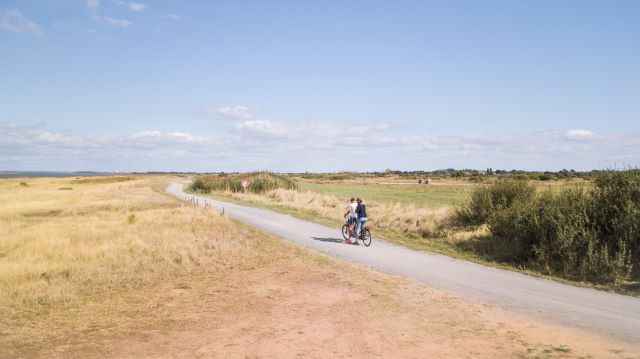
The estuary discovery trail
On foot or on horseback, follow the estuary discovery trail linking Corsept to Saint-Brévin-les-Pins. This greenway is part of the“Loire à Vélo” itinerary. You’ll discover some of the emblematic landscapes of Europe’s last wild river: estuarine meadows, fisheries, the industrial giants of the north bank, as well as the estuary’s flora and fauna (ducks, grey herons, common snipe…). In Saint-Brevin, stroll among the pine trees lining the seaside villas or relax on the vast sandy beaches.
- Start: Maison Verte harbour, finish: St-Brevin-les-Pins, distance: 9.4 km, level: easy.
L’observatoire des géants industriels, an unprecedented view of the Loire River
The “La Loire à Vélo” route leads to the observatory of industrial giants. This vantage point offers an unparalleled panorama of the Saint-Nazaire bridge, the carrelets de pêche (fishing huts) and port infrastructures such as the Cordemais power station. An orientation table shows the location of the various installations on the north shore of the estuary.
Saint-Martin Church
A central element of Corsica’s heritage, this Gothic-Romanesque church, whose Latin cross-shaped bell tower catches the eye of walkers, is home to some remarkable heritage objects. Among its treasures are a bell dating from 1716, recently listed as a historic monument, and a 9th-century baptismal font. The church is open daily from 10 a.m. to 5 p.m. (until 7 p.m. in July and August).
- The church is open daily from 10am to 5pm (until 7pm in July and August).
Le Manoir du Pasquiaud
The Manoir du Pasquiaud is another of Corsept’s landmarks. It was the residence of Nantes landscape painter Charles Le Roux (1814-1895), a pupil of Camille Corot. This manor house is not open to visitors, but its surroundings have been landscaped for picnics.
Saint-Nicolas Island
From the small port of Corsept, follow the dike to admire Ile Saint-Nicolas, the last wild island in the Loire before the ocean. Classified as a Natura 2000 zone, this two-hectare islet has a rich history. The island was used as a rear base by the Vikings to attack Nantes, then as a quarantine zone for sick sailors. Today, many birds nest here in spring.
- The trail between Corsept and Saint-Brevin allows you to get up close and personal. Otherwise, guided tours are available during the summer. Book with the tourist office.
The menhirs of Corsept
Corsept is home to several dolmens and menhirs that bear witness to a significant human presence in the Neolithic period. Among these megaliths, the 2m70-high Pierre Bond menhir overlooks the Gédeau marsh. Located in the hamlet of La Chaperonnais, the Pierre Blanche menhir is 1.60 m high. Legend has it that barren women used to rub their bellies against it before conceiving a child.
Also worth a visit is the menhir at La Mégerie, 4 km south-west of Corsept. The rectangular menhir is 2.60 m high and 1.20 m wide. A little further on, the Champs-Cassis menhir (also known as Pierre Levée) stands out for its particular shape. Very wide at the base, it tapers towards the top and its thickness is disproportionate to its size (3m78).
photo©J. JEHANIN