

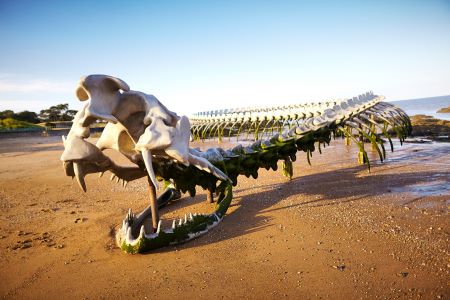
On the beach at Saint-Brévin-les-Pins, near Saint-Nazaire in Loire-Atlantique, the serpent d’Océan attracts the curious. Here are 5 things you need to know about this spectacular work of art, which appears at every tide.
How big is it?
Located north of Saint-Brévin-les-Pins, on the Nez de Chien beach, the Serpent d’Océan takes the form of a sea serpent skeleton measuring 120 meters in length. It looks like a mega-dinosaur skeleton straight out of a natural history museum! At low tide, you can walk around it. Many tourists come to take photos in front of the animal’s gaping maw.
When was it built?
Now one of Saint-Brevin’s must-see sites, the Serpent d’Océan was created in 2012 as part of the third Estuaire contemporary art biennial. This monumental sculpture is part of the Estuaire Nantes Saint-Nazaire itinerary, an itinerary of 34 works of contemporary art by today’s leading artists, accessible by road, bike or boat.
Who designed it?
Le serpent d’Océan is a work of art conceived by Huang Yong Ping, a Chinese artist exiled to France in 1989 after the tragic events of Tien An Men Square. A major figure in the Chinese artistic avant-garde of the 1980s, Huang Yong Ping is known for his monumental creations influenced by Dadaism and Surrealism. After living and working in France for 30 years, he became an honorary citizen of the town of Saint-Brevin in 2014. He died in 2019, aged 65.
How was it made?
This gigantic snake is made of marine aluminum, a high-strength metal used by the Chantiers de l’Atlantique in Saint-Nazaire and the Airbus site on the opposite shore. The snake’s skeleton is made up of 154 parts (vertebrae, ribs, jaws and head). Each element was cast in a workshop in China. A metal “bone marrow” runs through the entire skeleton to articulate the 135 vertebrae, and steel posts support the structure of the sea monster. The installation took eight weeks!
And why is the Serpent d’Océan displacing the Louvre on Google Street View?
Did you know that the Saint-Brevin snake is the second most searched site on Google Street View, behind the Eiffel Tower ? Discovered on Google Maps by a user who described it as a skeleton of Titanoboa, the largest snake ever known from the Jurassic period, the Serpent d’Océan went viral on social networks!
photo©La Vélodyssée/ A. LAMOUREUX