

On the left bank of the Loire estuary, Paimboeuf is a small town where history and nature are one. It’s not the most touristy town in the Loire-Atlantique region, yet it’s the perfect place to indulge in the dolce vita of the Loire. What to do, what to see, where to walk in Paimboeuf? Follow the guide!
A little history of Paimboeuf
A former Loire island, Paimboeuf is a discreet town where you need to take your time to discover its rich heritage. Its port was once one of the most important on the Loire estuary. Its quays served as an outer harbor for the port of Nantes. Many ships were built and fitted out here in the 18th century. On the eve of the French Revolution, the city of Paimblot had a population of almost 9,000, while Saint-Nazaire was home to just 700.
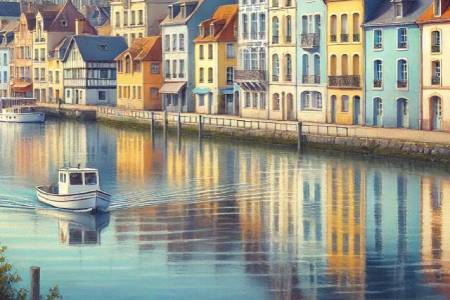
Today, Paimboeuf is like a history book. From the quays lined with colorful fishermen’s cottages to the Chaussée Neuve lighthouse, via the beautiful shipowners’ residences, each stone tells a story of the town’s maritime past.
The Paimboeuf interpretation circuit
For self-guided tours of the town and the banks of the Loire, a 10-panel interpretation trail highlights Paimboeuf’s architectural and cultural heritage.
This 4-kilometer walk (approx. 1h45 walking time) starts at the Tourist Office, where the first panel introduces you to the history of the port. Then discover the old railway station, the Hailaust and Gutzeit timber yards, and the hospital chapel, one of Paimboeuf’s oldest buildings.
Along the way, we pass the remains of the old rope factory, which remained in operation until 1964, and the Pierre-à-l’Œil tower, a 1780 fire tower and forerunner of lighthouses. The Chaussée Neuve lighthouse (the only lighthouse in the Loire estuary) and the Grand Fer à Cheval slipway complete the tour.
- In summer (July and August), guided tours of Old Paimboeuf are organized by the Tourist Office, quai Sadi Carnot, Information by phone: 02 40 27 53 82.
Saint-Louis church
The neo-Byzantine Saint-Louis church is a unique architectural gem in the Loire-Atlantique region. Inside, you can admire a listed high altar, composed of fourteen precious marbles, and a monumental painting by Alexis Douilard, La Mort de Saint-Louis à Tunis, which adorns the vault.
The quays and port of Paimboeuf
The quays of Paimboeuf, nestled between two arms of the Loire, offer a peaceful stroll around the port. The colorful facades of the fishermen’s cottages, the wrought-iron balconies of the shipowners’ houses and the narrow lanes, which provide protection from the wind, are reminders of the town’s maritime past. Are you a fisherman? Settle down on the quays and, with a single line or a plaice, fish for eels, sea bass and mullet.
The Canal de la Martinière
Built in 1892 to facilitate navigation between Nantes and Saint-Nazaire, the Canal de la Martinière (or Canal Maritime de la Basse Loire) stretches over 15 kilometers. This 19th-century hydraulic feat bears witness to the ingenuity of the engineers of the time. A walk from the Carnet locks allows you to discover this impressive structure.
Did you know ? At the height of the Cold War, between 1958 and 1968, the United States occupied the canal entrance at Le Pellerin as part of a NATO base. The U.S. Army stored strategic equipment there, which was never used.
A cruise on the Loire
Depart from Paimboeuf and board a flat-bottomed boat for a 2? hr. guided river cruise along the south bank of the estuary, where the ocean meets the Loire. Paimboeuf <– > Lavau-sur-Loire (Return): departure from cale du phare, quai Boulay Paty ( 12 passengers).
Paimboeuf by bike: ride young!
Get on your bike and explore Paimboeuf by bike. A 16 km route links Paimboeuf to Saint-Brevin, and follows both the Loire à Vélo and the Vélodyssée, two renowned cycle routes. Along the way, enjoy the view of the Saint-Nazaire Bridge and discover the Serpent d’Océan, an impressive sculpture resting on the beach.
Hiking trail: a path to enjoy nature
A nature trail offers the chance to discover Paimboeuf in all its diversity: the pine forest, the Loire as far as the lighthouse, the Saint-Nazaire bridge and estuary, the flora and fauna, and more. Take a detour to Jardin Étoilé, a contemporary work designed byartist Kinya Maruyama. Inspired by the Big Dipper constellation, this garden is an original place for relaxation and observation on the Parcours Estuaire.
What about the beach in Paimboeuf?
At the end of the 1970s, Paimboeuf still had a small beach of golden sand, between the lighthouse and the yacht club. This beach, reclaimed from the Loire, was formed by sand deposits. Today, unfortunately, the beach has disappeared…
If you don’t want to go too far from Paimboeuf for a swim, the nearest beach is Saint Brévin les Pins (12 km away). You can also take advantage of the swimming area at the Saint-Viaud leisure center. The landscaped beach is a summer favorite.
Campsite near Paimboeuf
Just 15 minutes from Paimboeuf, discover our Paradis Les Rochelets campsite in Saint-Brevin. Here you’ll find mobile homes, chalets and camping pitches by the sea and close to nature in the Loire-Atlantique region. Take advantage of the aquatic area with its slide, lagoon, paddling pool and indoor heated pool with bubble spa. Book your stay at a 4-star campsite in Loire-Atlantique now and enjoy a 100% relaxing vacation!